
The global demand for lithium has skyrocketed over the last several years due to the rapid growth of the electric vehicle market and grid-storage solutions. Currently, production capacity is limited and unlikely to meet future needs. However, researchers are making headway in innovative lithium capture technologies. A new study, published in Device, describes one such technology that extracts lithium from seawater more efficiently than previous extraction methods, with an added benefit of seawater desalination.
Subscribe to our newsletter for the latest sci-tech news updates.
Abundant lithium, but limited access
Seawater contains vast lithium reserves totaling around 230 billion tons. However, methods for extracting it are limited due to challenges surrounding low lithium concentrations and high levels of competing sodium ions. While seawater concentrations of lithium are around 0.2 mg/L, concentrations of sodium ions exceed 12,000 mg/L. Interference from the high concentration of other ions made methods like electrochemical intercalation, nanofiltration, and liquid-liquid extraction too inefficient for practical use.
RECOMMENDED FOR YOU
Methods using lithium-ion sieves (LISs), such as hydrogen manganese oxide (HMO), show promise in lithium selectivity, but still have slow adsorption kinetics due to the low concentration of lithium in seawater. When combined with interfacial evaporation, LISs have better adsorption. However, enrichment of other ions then leads to lithium scaling before reaching sufficient lithium levels for effective adsorption. This scaling makes evaporation more difficult and blocks the adsorption of lithium.
Overcoming these limitations, however, offers a far more environmentally friendly method of obtaining lithium in the future. Currently, lithium mining from land-based methods is destructive and leads to increased pollution and excessive water consumption.
The solar-powered seesaw extractor
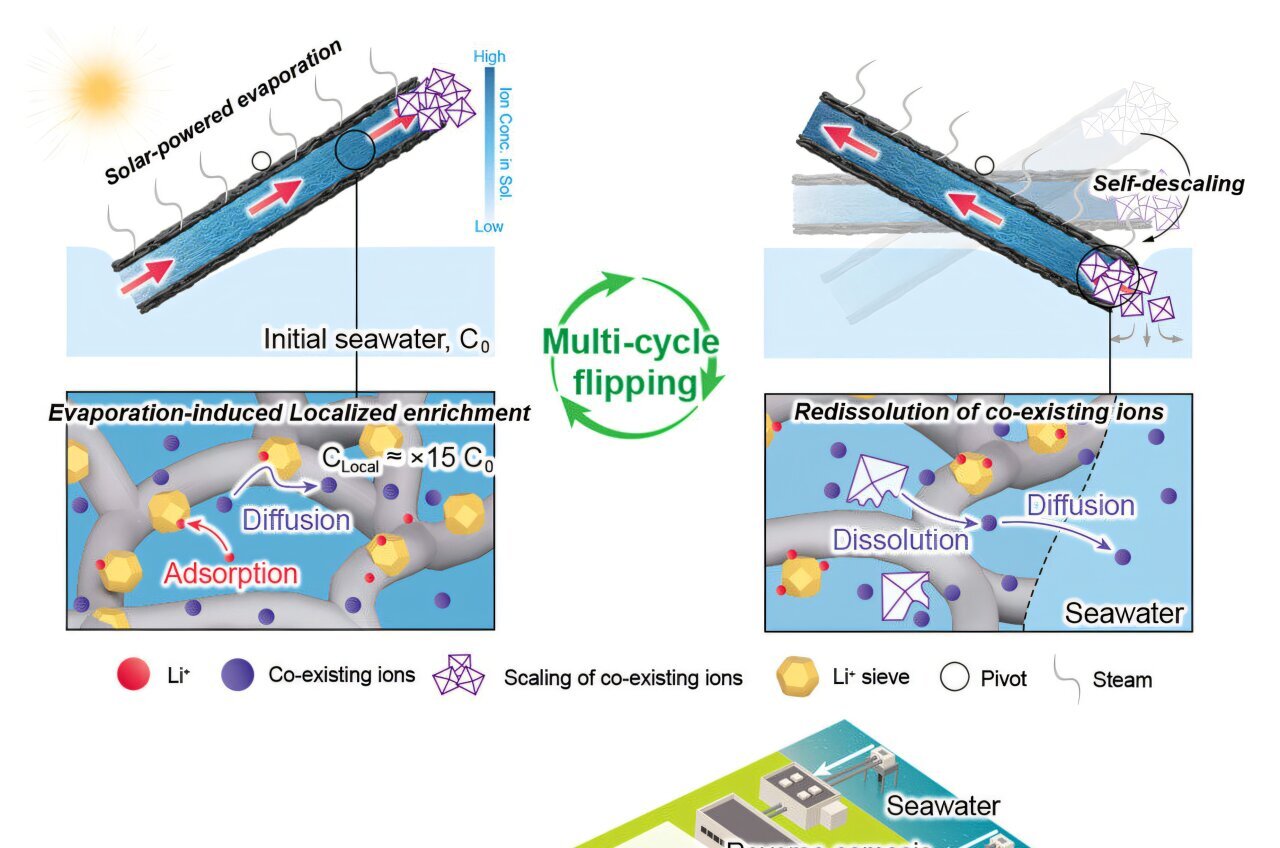
The research team involved in the new study seems to have overcome some of the limitations associated with prior seawater lithium extraction with the use of their newly developed solar-powered seesaw extractor (SPSE). The SPSE consists of a hydrophilic lithium-adsorbent layer sandwiched between two hydrophobic photothermal layers.
The device uses sunlight to drive evaporation, creating capillary flow that enriches lithium in the adsorbent layer. Each extractor starts off tilted at a 30-degree angle and slowly tilts in a seesaw-like motion as scaling builds up at the top. When this part is submerged in water, salts dissolve, removing the scaling and starting over.
“In the SPSE, the hydrophilic nanofibrous mat functions as both a capillary pump for ion transport and a reservoir for Li+ capture. It is filled with water through capillary flow, enabling continuous ion transport alongside evaporation.
“The upper carbon paper converts light into heat for evaporation, and the lower carbon paper enables the extractor to float on the water surface and reduces the dragging force from the liquid bridge. The hydrophobic layers help direct the salt deposition to the edges of the SPSE, mitigating scaling on evaporation before rocking,” the study authors write.
The device achieved a 15.5-fold increase in local lithium concentration, boosting adsorption kinetics. The SPSE separated lithium and sodium by a factor exceeding 370,000, allowing for more effective lithium collection. The team also notes a valuable byproduct of high-purity water with “drinking-water quality standards” when further optimization was incorporated.
The researchers compared the tilted seesaw model to a fully submerged model. The experiments showed better results with the seesaw version, with lithium uptake 69% higher over 120 hours compared to immersion methods.
Further improvements
The SPSE presents a sustainable, solar-powered solution for resource extraction and water purification, but it has not yet reached its full potential. The device was found to suffer from performance degradation of 21.6% after 30 cycles due to instability of manganese-based lithium sieves. There is also still some question about the device’s function in real marine environments. Most LISs require alkaline conditions, necessitating pH adjustment in real seawater.
To overcome these limitations, the study team suggests replacing manganese-based LISs with titanium-based LISs with better stability and integrating materials or approaches that can capture lithium at natural seawater pH in future models.
Written for you by our author Krystal Kasal,edited by Gaby Clark, and fact-checked and reviewed by Robert Egan—thisarticle is the result of careful human work. We rely on readers like you to keep independent science journalism alive.If this reporting matters to you,please consider a donation (especially monthly).
More information: Yi-Zhou Chen et al, Solar-powered self-descaling seesaw extractor for lithium production from seawater, Device (2026). DOI: 10.1016/j.device.2025.101028
© 2026 Science X Network
This story was originally published on Tech Xplore.
Finished reading? There’s more to explore.
Leave a Reply