
By Rhett Ayers Butler
Lisa Miller did not arrive at biodiversity finance through spreadsheets or climate models. Her starting point was animals. Growing up in Australia, she was drawn to wildlife in a way that preceded any broader argument about conservation, and by the age of six she already imagined a future working with them. In the 1980s, as habitat loss entered the public conversation, that interest deepened. The release of Gorillas in the Mist coincided with a school project on mountain gorillas and Dian Fossey. It was an early alignment. Nature was not abstract; it was specific, already under pressure, and often fragile in ways that were easy to overlook.
That trajectory led her to study zoology, and then to the Australian Museum, where she worked across several scientific departments, including ichthyology. The work was technical, shaped by long hours of observation and the routines of classification. Another influence proved just as lasting as the science itself. Within the museum, Miller became involved in science communication, helping translate research for public audiences. Some visitors arrived with curiosity, fear, confusion, or indifference. Many left with a clearer sense that the natural world was closer to their own lives than they had first assumed. The experience made her more aware of how knowledge moves, and in what happens when it does not.
RECOMMENDED FOR YOU
[(https://imgs./wp-content/uploads/sites/20/2026/01/30215424/Wedgetail-Founder-Lisa-Miller-building-a-leaky-weir-at-The-Quoin-credit-James-Hattam.jpg)
1.4 Wedgetail Founder Lisa Miller building a leaky weir at The Quoin. Photo credit James Hattam.
In the early 2000s, that question increasingly pointed toward the web. Museum science teams worked alongside early digital projects, at a moment when the internet still carried the promise of widening access rather than narrowing attention. Miller moved toward technology less from disinterest in science than from a sense that it offered tools missing from academic and institutional settings, including ways to build organizations that could endure. Over the next 18 years, she worked across technology organizations of different sizes, absorbing lessons about entrepreneurship and growth, as well as how capital and execution shape outcomes.
Those lessons became personal as well as professional. Through her partnership with her husband, Cameron Adams, a co-founder of Canva, Miller witnessed the company grow from a small team into a global platform. It was an education in what it takes to build something durable, and in how quickly resources begin to cluster once a model starts to work. It also brought a reckoning. By 2019, with both financial resources and business experience available to her, the question shifted from what could be built to what should be done.
That year sharpened the stakes. Scientific reports increasingly linked climate change and biodiversity loss as intertwined crises. In Australia, catastrophic bushfires underscored what those abstractions meant on the ground. Species were lost, and landscapes changed in ways that could not be reversed. For Miller, it felt like a recalibration point. The issue was no longer whether nature mattered. It was whether capital and business knowledge could be redirected in time to make a difference.
[(https://imgs./wp-content/uploads/sites/20/2026/02/08173652/AP20008263499663.jpg)
Controlled burn near Tomerong, Australia, on Jan. 8, 2020, in an effort to contain a larger fire nearby. (AP Photo/Rick Rycroft)
The result was the creation of the Wedgetail Foundation, a nature-focused philanthropic and investment venture built around a blended-capital approach. Wedgetail combines philanthropic funding with loans, selective equity investments, and direct ownership and management of conservation land. The aim is not simply to protect nature, but to understand what it actually takes to do so. In Tasmania, the foundation owns thousands of hectares of land it describes as “lighthouse properties.” These landscapes are actively managed for conservation and restoration, while also serving as places for learning. They are sites where corridors are replanted, species are reintroduced, and researchers are invited to work over long time horizons.
Working directly in landscapes has shaped Miller’s view of conservation finance in practical ways. From a distance, capital moves easily. On the ground, progress is shaped by seasons, access, infrastructure, and the everyday realities of people’s lives. Restoration moves at the pace of ecosystems and communities, not funding cycles. The experience has reinforced a view that biodiversity loss is a global crisis, but one that is addressed locally, through relationships, long-term presence, and patience.
[(https://imgs./wp-content/uploads/sites/20/2026/02/09003359/Photographique-Studio-Wedgetail-Cameron-Lisa-1.jpg)
Cameron Adams and Lisa Miller. Courtesy of Wedgetail.
That perspective runs through Miller’s thinking about investment and philanthropy more broadly. She is wary of rigid distinctions between what is considered “investable” and what is deemed purely charitable. Many biodiversity efforts fall between those categories, not because they lack value, but because economic systems have not learned how to recognize it. Nature remains largely invisible on balance sheets, even as it underwrites every economy that depends on it.
This interview explores how Miller arrived at these conclusions, and how Wedgetail is testing different ways of acting on them. It touches on financing gaps, measurement challenges, and the limits of current economic frameworks. It also returns, repeatedly, to people: to teams, communities, networks, and leaders, and to the conditions that allow conservation work to endure beyond a single grant or investment cycle.
What emerges is not a theory of salvation, but a working view shaped by experience and constraint. It treats biodiversity loss as neither an abstract tragedy nor a technical problem with a single solution. Instead, it is treated as a systemic issue, one that depends on capital, credibility, and a willingness to work over long time horizons.
[(https://imgs./wp-content/uploads/sites/20/2026/01/30215442/Wedgetail-Founder-Lisa-Miller-and-Head-of-Foundation-Karina-West-during-an-ecological-burn-at-Stockers-Bottom-at-The-Quoin.jpg)
Wedgetail Founder Lisa Miller and Head of Foundation Karina West during an ecological burn at Stocker’s Bottom at The Quoin
An interview with Lisa Miller
Rhett Butler for : Your investment focus includes biodiversity and nature-based solutions — what first sparked your personal and professional interest in this space?
Lisa Miller: Like many people in the space, it’s a really long-term passion. I have early memories of having a deep passion for animals, especially wild animals out in the world across all sorts of different countries. I can remember thinking, when I was around six, how much I wanted a career working with them. At that time, in my head, that meant being a zoologist.
In a way, it was about supporting them. You might remember that in the 1980s, a lot more was starting to be talked about around habitat destruction and related issues. I remember in year six, Gorillas in the Mist came out, and I did a big project on mountain gorillas and Dian Fossey. That passion kept building.
I was able to go and study zoology at university here in Australia. It was incredible to study all those topics I’d always wanted to explore around animal behavior and ecology. I ultimately moved into a role at the Natural History Museum in Sydney, Australia—the Australian Museum.
[(https://imgs./wp-content/uploads/sites/20/2026/01/30215453/A-wedge-tailed-eagle-inspecting-a-cage-at-The-Quoin-captured-by-a-camera-trap.jpg)
Wedge-tailed eagle at The Quoin. Photo credit Doug Gimesy
I worked in several science departments there, the main one being ichthyology, the study of fish. But I also got the chance to work in an area called Search and Discover, which was the science communication part of the museum. That did a couple of things. First, it taught me that a lot of impact comes from translating science for the rest of the world, which is something you’ve obviously done in your career—helping people understand the natural world. Even in Search and Discover, people would have real learning moments where they’d reconnect with the natural world, not as something dangerous to be scared of, but as something important and interconnected with ecosystems.
The other thing it taught me was that the web team was also in the same department, and this was the early 2000s. I started helping them write science communication pieces and eventually began working across web projects, which was a big deal at that time. After the dot-com crash, there was new hope that the web could be a place to bring down barriers to access to information and support collaboration around the world.
I transitioned into a technology career because there were elements I hadn’t encountered in the science world—around entrepreneurship and business models. I worked in technology for about 18 years, but always stayed attuned to what was happening in the biodiversity and climate crises, and tried to think about how I might eventually reconnect those things.
I was fortunate to work in lots of different organizations—small agencies and big corporates—and then ultimately alongside my partner, who’s one of the co-founders of Canva. That was a huge lesson in working at a startup: going from something very small—just a few people—to many people, many users, far more capital being deployed, and revenue coming in, and understanding what that takes. Even though we had other failed business ventures, that one has gone really well.
[(https://imgs./wp-content/uploads/sites/20/2026/02/08173640/AP19357177218080.jpg)
In this image made from video taken on Dec. 22, 2019, and provided by Oakbank Balhannah CFS, a koala drinks water from a bottle given by a firefighter in Cudlee Creek, South Australia. (Oakbank Balhannah CFS via AP)
In 2019, there was some capital available for us to start thinking about what we should be doing—what our responsibility was with the money that came from the business and its success. That was also the year of the IPCC reports that really interlinked the biodiversity crisis and the climate crisis, and here in Australia, the massive bushfires occurred. That was a huge biodiversity loss event. It felt like a moment of recalibration: how could we, with what we’d learned and what I knew by then, redirect some of this capital and business knowledge back toward bending the curve on biodiversity loss?
: One of my first projects was on fish, and then science communication, so I appreciate that. How did you decide to start Wedge Tail and focus on biodiversity protection as the core part of that work?
Lisa Miller: Cameron and I felt there were lessons we’d learned in the world of business and startups that could be brought into the environmental sector. Not that we know more than people with deep expertise in ecology and related fields, but how do we better connect the two, get more people caring about the natural world, and reconnect nature to the economic system? Those lessons, along with capital, could be blended in different ways using different tools. We’re still on a significant learning journey around that, and I’m sure we’ll talk about it more.
The foundational idea was that we knew it would be a foundation, but we also thought, let’s try a ventures component as well. We call it “adventure conservation.” It’s not exactly the same as venture capital, but it borrows some of that thinking and applies it to this space.
We were trying to hold onto that underlying mission, which still sits within the ventures work: how can you restore and conserve biodiversity through sustainable investment? How can you generate returns—not only financial returns, but returns in nature: positive impacts on landscapes, and benefits for local communities and people? That was the underlying thesis.
[(https://imgs./wp-content/uploads/sites/20/2026/01/30215511/The-Wedgetail-team-after-our-2025-offsite-credit-James-Hattam.jpg)
The Wedgetail team after our 2025 offsite. Photo credit James Hattam
In Australia—I don’t know how hard it is in the U.S.—for a time, because there are a lot of legal steps involved in setting something up, we started by doing the ventures piece and experimenting with what we call NatureLink loans and other equity investments.
Now it all sits within the foundation, where we deploy grants—philanthropic capital—and also own some lighthouse properties here in Tasmania. That’s where we do conservation and restoration work with our own teams, and learn firsthand how much it costs and what it takes. The investment thesis still runs through all of that, but now within a more blended-capital approach, which the foundation allows.
: You mentioned lighthouse properties. I’m not familiar with that term. Could you clarify that?
Lisa Miller: We have about 8,000 hectares of landscapes here in Tasmania that the foundation owns. We call them lighthouse properties because there are incredible groups all around the world doing conservation work—private conservation foundations. There are many here in Australia, like The Nature Conservancy and Bush Heritage. We’ve purchased land with conservation in mind, but also with what we see as regenerative activities, including restoration, sustainable use, and adaptation.
We call them “lighthouse” properties because we’re trying to demonstrate approaches such as deploying nature technology and running different experiments in how you actively manage land, as well as providing access for people to come and learn more. The reasons for establishing these properties go beyond conservation alone. There are different facets: how do you tell stories, engage people, and bring them out to the property? And, how do you do conservation well?
[(https://imgs./wp-content/uploads/sites/20/2026/01/30215504/Two-forester-kangaroos-having-a-tussle-captured-by-a-camera-trap-at-The-Quoin.jpg)
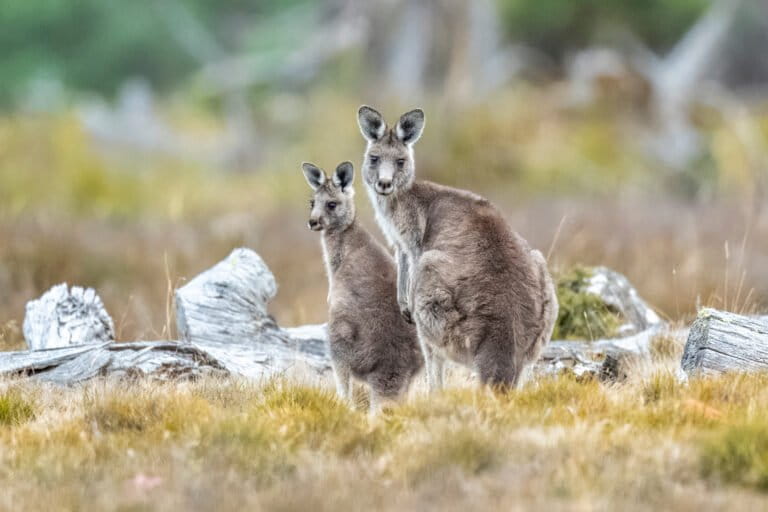
Two forester kangaroos having a tussle, captured by a camera trap at The Quoin
For instance, on one of them here, we’ve just planted 72 hectares to connect forested areas across the landscape. We’re running a restoration project to create corridors and, hopefully, connect habitat for small mammals in that area. We’re trying out these different approaches and breaking them down to understand how much they cost and what level of team effort they require. I’m sure the term has been used before, but it reflects the idea that this isn’t only about conservation.
: What has emerged out of that process so far? Are there any early lessons?
Lisa Miller: There’s a lot. One early thing we’re finding is that there’s a huge appetite from researchers. We have a lot of institutions that would like to work with us on that landscape. I think that’s because when you have a landscape and you’re willing to give people access—and there’s long-term access for science to be done—there’s a real need for that.
We’ve already been lucky to have a translocation project happen there, where eastern quolls were released with the University of Tasmania and the Tasmanian Land Conservancy. The fact that we had a site they felt was suitable helped make that possible. We’ve been surprised by how strong the demand is from scientists and institutions to access landscapes for long-term research.
The main learning to date is that, whether we’re talking about investment or philanthropy, working from a desk—sending emails and moving capital around the world—is relatively easy. Working in a landscape is really hard. You’re working at the pace of nature, at the pace of communities, at the pace of traditional owners—all of those things. Understanding that better helps us work with partners around the world and have empathy for things that might otherwise seem slow or difficult.
If someone says, “We can’t access that part of the landscape because it’s the wet season,” we know what that means. Or if a budget line went toward road repair, we understand why. We have more empathy for what it takes to resource a landscape and actively manage parts of it, rather than being naïve about those realities.
: Are there particular ecosystems, species, or geographies that you feel are especially urgent and overlooked?
Lisa Miller: I have this idea that the biodiversity crisis is a global crisis, but it’s solved locally. When we don’t fully understand the natural world, the hierarchy of how we rank importance—what is “important” to the biodiversity issue—often misses that local communities know what matters to them. They should be focusing on that, regardless of how we stack-rank threatened species or ecosystems.
[(https://imgs./wp-content/uploads/sites/20/2026/01/30215437/The-rocky-plateau-after-which-The-Quoin-is-named-credit-Matt-Newton.jpg)
The rocky plateau after which The Quoin is named. Photo credit Matt Newton
That said, tropical forests are obviously very high in biodiversity. They’re central to addressing the climate crisis as well. They interact with carbon sequestration and weather patterns. When you talk with climate scientists, forests always come up. We also know they’re seriously under threat.
A lot of our early focus in NatureLink loans, and some of the work we did in Indonesia and similar places, has been on forests—particularly tropical forests. We’ve also been looking closely at forests here in Australia.
I would also point to grasslands and prairies. People often don’t realize how incredibly biodiverse they are in many parts of the world, but they’re also highly threatened because they’re often the first places industrialized agriculture moves into. They’re rare in many regions. On the landscape we have here in Tasmania, we’re lucky to have some native grasslands, and they’re underrepresented. People often don’t think about grasslands, partly because we think of majestic trees and forests—and we should—but also because grasslands are often private, agricultural spaces, so many people don’t get access to them.
And then, when we talk about forests, we should also be thinking about marine and kelp forests, mangroves, and estuaries—their role as nurseries and their carbon. It’s all of those things together, but I’ll stop there, otherwise I’ll just list everything.
: Beyond grasslands, what other gaps do you see in financing for the biodiversity space? What types of solutions do you feel are struggling to attract capital or donations?
Lisa Miller: That question makes me think about the bigger picture: the general lack of funding. We all know about the biodiversity funding gap that’s been discussed for a number of years—something like $700 billion annually. I think it’s now going up to $900 billion annually. But it’s not that there isn’t capital in the world; it’s about how our systems are structured and where that capital flows.
That structural inequity is driving a lot of this. Humans have had a few centuries of incredible transformation—in technology, health, and how we live on the planet. A lot of what’s been beneficial for us has been built on ecological debt. We have the information to understand that debt. I think this generation understands it and knows we need to start paying it back. That requires a recalibration of priorities and reinvestment.
I see gaps across all forms of capital. In agriculture, there are definite gaps. People trying to do nature-positive work often aren’t financially rewarded. Subsidies don’t support them. So there are real gaps in how we support agriculture and in how governments subsidize agriculture.
[(https://imgs./wp-content/uploads/sites/20/2026/01/30215517/Zorzal-credit-Nettie-Atkisson_4760.jpg)
Cacao pods at Zorzal Cacao in the Dominican Republic. Photo credit Nettie Atkisson
I’d also say there’s a gap in philanthropic spending. The environment sector attracts, I think, two to three percent of philanthropic capital in Australia, and I think it’s similar in the U.S. There needs to be a recalibration. I’ve come to philanthropy through an environmental lens because we’re so passionate about it, but many philanthropists come through people-oriented lenses—poverty, education, health—which they should. The environment can seem too big and too hard, and it can be difficult to understand the return on investment. Sometimes it just feels too hard to tackle.
I also think the environmental community is doing incredible work, but how it communicates to philanthropists why they should invest in these spaces can become a bit of a chicken-and-egg problem. Some other sectors are more honed in how they attract philanthropic capital and open doors to it. Supporting the environmental sector to do the same is important.
More specifically, in technology and business, we’ve seen an uplift over the last few years in “nature tech” and similar areas, but last year it definitely took a dive. There’s the idea of a sustainability recession, combined with geopolitics and what’s going on in the U.S. and elsewhere—investment has pulled back. Many of these spaces need better measurement of biodiversity so it can fit with the kinds of investment requirements people are used to, while also continuing to innovate in restoration. That will need more support.
And I think we need more blending of capital again. There are incredible organizations—Superorganism is one example—doing work in this space and doing it well. But sustaining investment requires momentum to return, and I think philanthropic and investment capital need to work together more, because nature is still largely invisible in how we think about economics. That makes it hard to invest in across all of these spaces.
: In the U.S. it’s a similar percentage of philanthropy that goes to the environment. In recent years, a big chunk of that has been climate. If you pull out wildlife and conservation, the majority of money goes to domesticated animals. The amount that actually goes to biodiversity is quite small from the philanthropic sector.
You mentioned the nature-positive economy and the sustainability recession. Going back to your origin story and the communication side: do you see that as part of the gap? What do you think it would take to make the nature-positive concept mainstream?
Lisa Miller: I think you’re exactly right. One of our mission pillars is about transforming how society values nature. When we talk about valuing, we’re often speaking from a Western, capitalist mindset. A lot of Indigenous cultures already have a deep understanding of how to value nature, and that shows up in how they spend money, how they vote, and how they make decisions. That’s really the crux of it.
[(https://imgs./wp-content/uploads/sites/20/2026/01/30215412/Looking-down-at-Stockers-Bottom-credit-Matt-Newton.jpg)
Looking down at Stocker’s Bottom. Photo credit Matt Newton
When people talk to me about philanthropy needing to focus on people, I see our economy and livelihoods as sitting within the biosphere. To me, this is an investment in our species’ survival. A healthy biosphere and biodiversity—ecosystem services and all the things we depend on, even from a purely human-centric point of view—are fundamental.
That understanding comes from my science background, but it’s a key piece that I think many people don’t fully grasp. I think economists understand that the world is a finite resource, and more people are starting to understand that too. But the idea of just how finite it is still isn’t clear to a lot of people. The work of organizations like —helping people understand that our human-created systems sit within the biosphere, the atmosphere, and all these interconnected systems—is essential knowledge. It helps people see why these aren’t “nice-to-have” issues. They’re essential for all of us—for economies to survive, and for communities and people to thrive.
: Going back to the sustainability recession concept: if you could shift one thing in the global finance system tomorrow to accelerate investment in nature, what would that be?
Lisa Miller: It is a tricky question, and there are all these “magic wand” ideas. From an Australian standpoint—but I think this applies in most places—nature not being recognized in the economy is one of the key problems.
Legislation and policy development in most governments could address some of those structural issues and fundamentally change how finance flows into nature. In Australia, for instance, a lot of subsidies still flow toward the destruction of nature across a range of sectors. Changing how we subsidize things—by supporting more nature-positive activities and shifting subsidies away from harmful ones—could make a real difference.
Obviously, that requires political will, but legislation and policy can move quickly in many parts of the world. We’ve seen early examples of this in the U.K. and Europe. I know some measures have since been stepped back, but developments like biodiversity net gain, changes to subsidies, and new approaches to restoring land that isn’t viable for agriculture—and subsidizing that restoration—are important early steps. They begin to shift how businesses and investors think about where to allocate capital.
: A compelling example can move policymakers and other decision-makers. Is there a project you would point to as a success case that could be built off of or used as a model?
Lisa Miller: I was thinking through my use cases—what I tend to reference. I’m going to mention a few that might not be quite right for your audience, but I think debt-for-nature swaps are really interesting. They’re still being developed, but I find them compelling because they’re system-level and operate at scale. They think about whole countries and ecosystems, and about restructuring debt to generate outcomes for nature and get finance flowing. There’s a lot to learn there. Nothing’s perfect, but you can keep building on those ideas.
In Australia, I was also thinking of some very local examples. There was a collapse of a forestry company, and at that moment, capital came in quickly and purchased areas of forest. That’s fast capital moving into a space to achieve conservation outcomes—acting with business speed, but with a conservation goal.
That said, I’d be interested in your view. I don’t think those are quite gold-standard examples of how policy might change its mind. That’s part of what we’re on a journey to find—financial products, tools, and ways of thinking through supply chains that serve as really strong examples. I have pockets of examples, but I don’t have a single case where I’d say, “this is the gold standard.”
[(https://imgs./wp-content/uploads/sites/20/2026/01/30215404/A-leaky-weir-after-heavy-rainfall-credit-Matt-Newton.jpg)
A leaky weir after heavy rainfall. Photo credit Matt Newton
I guess we think in terms of three impact domains: nature, business, and people. Coming from a zoology degree, I never thought about people very much, but as you know—and as you’ve just expressed—people are at the heart of both the solutions and the problems. If people have good livelihood outcomes, good health outcomes, and good education outcomes, they’re also better able to care for landscapes. That’s where you get longevity in conservation and restoration outcomes.
I’ll definitely look up that project. I’m also thinking about more pocketed work we’ve done here around supporting Indigenous peoples to have ownership of land and develop commercial streams, and the ramifications that has back into the community—employment, access to health, healthier communities, and then you get a healthy country. How these things interrelate is the systemic piece. Giving clear, concrete case studies to policymakers is what’s key.
: You’re investing in a wide range of entities through grants, loans, and other mechanisms. What are some things you look for—either in the leaders or the organizations themselves—when you choose to back one?
Lisa Miller: I think that, just like we’ve had experience—as I mentioned, thinking about what venture capitalists look for—we look for similar things. From my experience in technology, and from watching the founders of Canva—Cameron, Mel, and Cliff—lead that business over a number of years, you gain a lot of insight into what it takes.
It comes down to vision, and often systems thinking—like what you expressed earlier. The strongest projects are system-changing. They’re often quite large, but the teams also know the next steps to get there. That first rung of the ladder matters. It’s one thing to have a massive vision and not know how you’re going to get there. It’s another to say, “We’re going to do all these things,” without connecting them back to the impact and the theory of change.
We look closely at whether the team can execute on the ideas. That doesn’t always come down to having extensive experience, but rather to how teams rally around goals and actually get things done. We like to meet teams and understand how they’re thinking about the project and how they plan to execute against those goals.
[(https://imgs./wp-content/uploads/sites/20/2026/01/30215418/The-Wedgetail-team-learning-about-leaky-weirs-at-Stockers-Bottom-credit-James-Hattam.jpg)
The Wedgetail team learning about leaky weirs at Stocker’s Bottom. Photo credit James Hattam
A lot of it is relationship-based. We look for good communication and trust. Especially with loans, we sign a lot of contracts, but trust is really at the core. There are times when things go wrong—whether it’s in a business or in projects in the natural world. You have environmental disasters and all sorts of challenges. You have to be in it together, not just pointing to the contract. You need to look at what happened, how you work through it together, and how you help get things back on track.
Communication is key—not only so you understand the problems and can help, but also to avoid power dynamics between the organization delivering the work and the one providing the funding. You don’t want to receive only the information people think you want to hear. You want a genuine understanding of what’s happening so you can actually be helpful. So a lot of what we look for comes back to the team and how they work together.
That then flows into the project itself. Some projects are large in terms of hectares or the number of people involved. Others are smaller, but they have that minimal viable product quality—they’re testing an idea or a new way of working in an ecosystem. More often than not, it comes back to the team.
: What advice would you give to an entrepreneur or an NGO leader hoping to scale an idea that protects biodiversity? And what about people in the Global South who often face barriers people in places like Australia and the U.S. may not?
Lisa Miller: It’s related to what we talked about: having a clear vision and being clear about where you start. Another piece is clarity—clarity in a few different senses. I’d recommend focusing carefully on how you tell your story. That’s critical. You know a lot about storytelling, and we see it as key to solving many problems. Being able to express clearly the impact you’re having, and why it matters—not just ecologically, but also socially and economically—is essential, especially when you’re speaking to philanthropists or investors who are far removed from the landscape.
That ability to craft what someone needs to know to understand the threats and opportunities you’re dealing with is crucial. I’d also emphasize the importance of building a strong, trusted team.
[(https://imgs./wp-content/uploads/sites/20/2026/01/30215431/The-Quoin-at-night-credit-Matt-Newton.jpg)
The Quoin at night. Photo credit Matt Newton
In the Global South, the challenges are often that capital is harder to access because it’s perceived as riskier. With the loans we do, we don’t think many of them are actually that risky, but there’s a persistent perception that businesses in some of these places are. I also think local knowledge in the Global South can be undervalued by external funders. So if you’re working in that space, it’s important to be thoughtful about both the capital you’re seeking and the funders you’re approaching.
As with anyone seeking funding, not all money is helpful. It’s about finding the right capital and the right partner—someone who will respect your knowledge and what you bring to the project, alongside what they’re bringing and the change they’re seeking.
One last thing is that there isn’t only one way to scale. In business—which is part of the reason for many problems in the natural world—there’s often an assumption of infinite growth. Some models shouldn’t just scale and get bigger and bigger. Some models are about replication: how something works in communities, and how you enable it in more places. In some Global South contexts, it’s not necessarily about becoming an incredibly large business. It might be about replicating a local model across many communities.
: What keeps you motivated in this work? And what gives you hope that it’s possible to reverse biodiversity loss?
Lisa Miller: The first thing that keeps me motivated is action. The action of our team motivates me, and the action of the partners we work with—whether they’re scientists, landholders, or community leaders. People being in action is an act of stepping into responsibility. There’s a responsibility I feel toward these landscapes and the natural world, and toward my community, and taking action is part of that.
That’s the source of active hope. A lot of people have talked about that idea, including Jane Goodall: you build hope through action. It’s not passive optimism. Action gives us hope. Just this morning, I talked to a partner from Colombia who’s incredibly excited about what’s happening, and you’re reminded that there’s so much work underway.
[(https://imgs./wp-content/uploads/sites/20/2026/01/30215359/The-Quoins-sandstone-escarpment-credit-Matt-Newton.jpg)
The Quoin’s sandstone escarpment. Photo credit Matt Newton
To go a bit deeper, I have an enduring love of the natural world. It started really young, and that constantly motivates me. It’s curiosity, and love for it—love in the sense that I’m energized by action to protect it and support it. I don’t have to see it all; that connection is just there.
Another piece builds on that: working with partners. There are lots of people who’ve worked actively in this space for decades—yourself included—who are inspirational. We’ve been welcomed by people who’ve done environmental philanthropy for a long time, and they’ve shared their stories and advice: “Don’t do this,” “Do this,” “Think about that.” That support, and the hope that we can offer the same kind of guidance to others, is motivating.
And at the base of it is justice. Justice for people, and justice for the other species we share the planet with. When you think about the destruction of habitats and things like that, the justice piece is also what gets me out of bed in the morning.
[(https://imgs./wp-content/uploads/sites/20/2026/01/30215448/Forester-kangaroos-at-The-Quoin-credit-Doug-Gimesy.jpg)
Forester kangaroos at The Quoin. Photo credit Doug Gimesy
This article was originally published on
Finished reading? There’s more to explore.
Leave a Reply