OpenAI returned this Super Bowl season with its second commercial, leaning into an expansive idea: the ability to build anything.
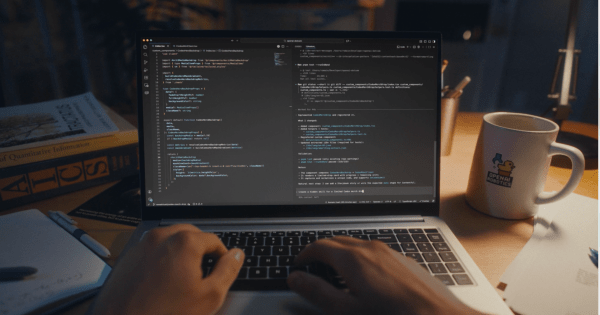
The 60 second spot, aired during the end of the first quarter, opens with what appears to be a child’s hand tracing the outline of a cobweb. From there, the spot follows a single through-line of curiosity–moving from classroom notebooks and science books to lines of early code, a Linux DVD slid into an aging computer, and eventually to more modern scenes of building robots and working alongside ChatGPT to code.
The ad positions OpenAI’s Codex–its coding assistant launched last year–as the latest step in a long history of computer coding.
RECOMMENDED FOR YOU
“We’re living through a time when people can build things that were previously out of reach,” Kate Rouch, CMO of OpenAI told . “The message is around participation, agency and leaning in to use these tools to do things that you just couldn’t before.”
The national ad runs alongside a rotation of regional spots drawn from a two-minute video series titled Real Stories, which takes a documentary-style approach to highlighting everyday builders using ChatGPT to run and grow their businesses. One spot features a small tamales business owner using ChatGPT to map out which farmers’ markets to sell at. These regional ads are running in markets including New York, Los Angeles, San Francisco, Chicago, Philadelphia, Boston, Las Vegas and Dallas.
Rouch framed Codex as an early but visible example of how AI is shifting from answering questions to taking action. “Now AI is not only answering your questions, but it is going to do things on your behalf,” she said, describing Codex as a sign of a “material” change underway in the industry.
Since August, Codex has grown 20x and is expanding at roughly 10% week over week, with a million people using it last month to build apps and websites, per OpenAI.
“Coding is the first example where AI is acting on behalf of people at scale-that behavior of agents is a story that regular people will start to see in their lives,” Rouch said.
OpenAI positioned the campaign as a top-of-funnel effort aimed at driving awareness of Codex. The company leaned on Sora and ChatGPT for ideation and production, though the final ad features real people rather than AI-generated characters. The ad was produced by Doomsday Entertainment, with editorial by MakeMake and visual effects by Trafik.
OpenAI spent $14 million on its Super Bowl debut last year; this year’s buy, which entailed advance ad commitment, was “roughly consistent” with that investment, Rouch said.
OpenAI’s Super Bowl return also landed amid a shifting competitive landscape, as the lines between how major AI players position their tools: While OpenAI has historically framed ChatGPT as a broad, everyday-use product, competitor Anthropic has pitched Claude as a tool particularly suited for coding work. As OpenAI pushes Codex to a mass audience, those distinctions are blurring.
This tension between the two companies played out publicly during the Super Bowl ad cycle. Anthropic aired its own spot that took aim at OpenAI introducing advertising inside AI its chatbot’s free and Go tiers.
“My first reaction [after seeing Anthropic’s ad] was personal,” Rouch-who was diagnosed with breast cancer last year-told . “It’s critically important that people have free access to these tools. I’ve been really public about navigating a very complicated health situation, and I used ChatGPT to do that. It gave me a lot of empathy and understanding for how access to powerful AI is helping people in their everyday lives.”
Rouch emphasized that ChatGPT allows free users to avoid ads, though it limits the number of queries they can make.
“The way that Anthropic’s ads are constructed is just not true to how ads will appear in the free ChatGPT,” she said. “Free access to this technology is critical. Your ability to pay isn’t the thing that determines if you have access to AI or not.”
Finished reading? There’s more to explore.
Leave a Reply